Analyse technique de l’œuvre « The Darkness Before Dawn »
Analyse technique :
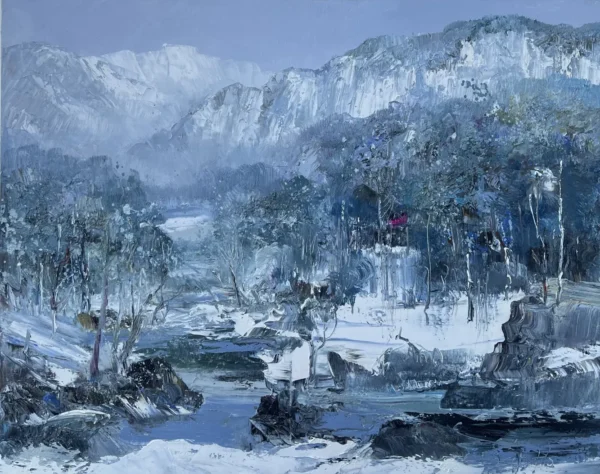
« The Darkness Before Dawn » est une création picturale à l’huile sur toile qui se distingue par un usage subtil des contrastes. La technique de Baisong Wang se caractérise ici par des coups de pinceau tantôt fluides, tantôt plus affirmés. Ils confèrent à la scène une impression d’atmosphère brumeuse et mystérieuse. Le travail de superposition de couches, où des teintes sombres prédominent, dégage un effet fantomatique. La palette de couleurs, dominée par des tons de bleu, de gris et de noir, crée une impression de froideur et d’humidité, évoquant l’heure sombre précédant l’aube. Wang exploite aussi des effets de fondus et de flous qui ajoutent de la profondeur au paysage tout en floutant les contours des éléments, renforçant l’ambiguïté et l’étrangeté de la scène.
Analyse stylistique : Le style de Baisong Wang dans cette œuvre se situe à la frontière du réalisme et de l’abstraction. Les formes sont à peine discernables, comme dissimulées par l’obscurité de la nuit. Les éléments du paysage, notamment les arbres et les structures en arrière-plan, se fondent les uns dans les autres, créant une atmosphère énigmatique. La ligne entre le ciel, la terre et l’eau est délibérément brouillée, reflétant une esthétique dans laquelle le monde naturel se dilue. Le choix de tons froids, en particulier les nuances de bleu et de gris, accentue le sentiment d’attente et de suspense. L’œuvre capture ce moment fragile avant le lever du jour, quand le paysage semble pris dans une transition silencieuse. Wang fait également appel à une technique de mélange de couleurs, où certaines teintes plus vives (comme des nuances pastel au bas de l’œuvre) se fondent subtilement avec les teintes plus sombres. L’effet est saisissant et suggère l’arrivée imminente de la lumière. Cette approche contraste fortement avec le reste de la composition plongée dans une semi-obscurité.
L’influence du style chinois traditionnel : Dans « The Darkness Before Dawn », Baisong Wang continue d’intégrer des éléments propres à la tradition chinoise, notamment dans sa manière de traiter l’espace et la lumière. L’influence de la peinture de paysage traditionnelle chinoise (shanshui) se manifeste ici par la manière de suggérer une atmosphère éthérée et intemporelle. Comme dans l’art chinois ancien, l’accent est mis sur l’expérience spirituelle du paysage plutôt que sur sa reproduction réaliste. L’œuvre exprime une forme de contemplation propre à la tradition chinoise. Le paysage n’est pas un simple lieu à observer, mais un espace où l’âme peut errer et méditer sur les mystères de l’univers. Les montagnes et les arbres, à peine discernables, évoquent l’idée de la nature comme force indomptable et mystérieuse, une thématique récurrente dans la peinture chinoise. La manière dont Wang laisse certaines parties de la toile floues ou inachevées rappelle également l’art de l’encre chinoise car le vide est un élément aussi essentiel que le plein, permettant ainsi à l’imaginaire de se développer.
Analyse symbolique : « The Darkness Before Dawn » est une œuvre profonde, où la transition entre la nuit et le jour devient une métaphore de l’attente et du renouveau. Symboliquement, ce moment entre l’obscurité et la lumière représente un passage : l’angoisse ou l’incertitude avant une transformation, avant l’éveil de la lumière. Wang capte ici une suspension temporelle, une anticipation de ce qui est à venir, ce qui donne à l’œuvre un sentiment mystique. Le contraste entre les ombres profondes et les nuances plus claires qui apparaissent subtilement dans le bas de la composition évoque le thème du yin et du yang, la coexistence de forces opposées qui, ensemble, créent l’harmonie universelle. L’obscurité pourrait symboliser les moments de confusion ou de doute, tandis que les reflets lumineux annoncent l’espoir et la possibilité de renouveau, une thématique souvent abordée dans la philosophie chinoise. L’utilisation de la lumière à l’horizon qui commence à émerger, symbolise également l’espoir et la résilience, suggérant que même dans les moments les plus sombres, la lumière est prête à percer. Ce message profondément symbolique résonne avec une dimension spirituelle, où la contemplation de la nature permet de réfléchir à la condition humaine.