Analyse du tableau Guilin Landscape B de Baisong Wang
Éléments biographiques : Baisong Wang, né en 1952 dans la province de Liaoning, est un artiste chinois reconnu pour sa capacité à capturer les paysages naturels à travers une technique de peinture à l’huile qui fusionne les traditions picturales chinoises et l’esthétique contemporaine. Formé à l’Académie des Beaux-Arts Lu Xun, il s’est fait un nom en créant des œuvres qui révèlent la beauté et la spiritualité des d’éléments naturels.
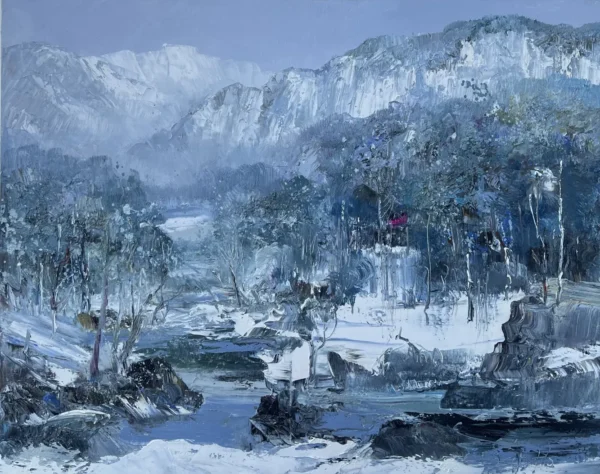
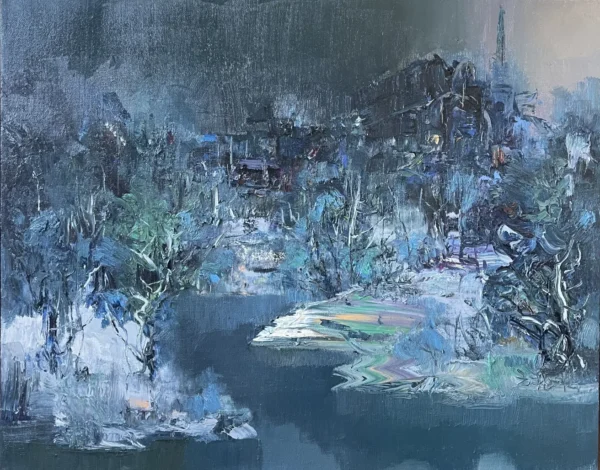
Analyse technique : « »Guilin Landscape B » » est une peinture à l’huile sur toile où Baisong Wang utilise une palette de couleurs douces, dominée par des nuances de gris, de bleu et de vert, pour représenter le paysage montagneux typique de Guilin, célèbre pour ses formations karstiques spectaculaires. La technique picturale met en évidence la profondeur du paysage, en particulier grâce à l’utilisation du dégradé de couleur et de la brume qui enveloppe les montagnes. Les touches de peinture sont appliquées de manière fluide, créant un effet vaporeux qui amplifie l’atmosphère de la scène. Les zones d’eau calme et les petits détails de végétation sont rendus avec une grande délicatesse. Elles contrastent avec les montagnes imposantes.
Analyse stylistique : L’œuvre s’inscrit dans le style particulier de Baisong Wang, qui marie des éléments de la peinture traditionnelle chinoise à une approche plus moderne en utilisant de la peinture à l’huile. Le paysage de Guilin, connu pour ses pics verticaux et ses rivières sinueuses, est ici traité avec une certaine abstraction. Les formes naturelles sont à la fois reconnaissables et fondues dans un environnement brumeux. L’espace est organisé de manière à diriger l’œil du spectateur vers l’arrière-plan, où la brume masque partiellement les montagnes.
L’influence du style chinois traditionnel : « »Guilin Landscape B » » est imprégné de l’influence de la peinture chinoise de paysage (shan shui), où la nature est représentée non seulement pour sa beauté visuelle, mais aussi pour son symbolisme spirituel. Les montagnes, l’eau et la brume, des éléments classiques de la peinture chinoise, sont ici reconfigurés à travers la technique de l’huile. La composition met l’accent sur la relation entre le plein et le vide, une notion essentielle dans la tradition chinoise, où le vide (ici, la brume) est aussi important que les éléments solides. Les montagnes, symboles de force et de permanence, dominent le tableau, tandis que la rivière, fluide et calme, renvoie à l’idée de la transformation et du mouvement perpétuel.
Analyse symbolique : Ce paysage évoque la tranquillité et la contemplation, thèmes récurrents dans la peinture traditionnelle chinoise. Les montagnes imposantes, représentent la force immuable de la nature, tandis que la rivière calme, presque immobile, suggère le passage du temps et le flux constant de la vie. La brume qui enveloppe les montagnes symbolise le mystère, un espace dans lequel la réalité se fond devient rêve. Le petit groupe de maisons près de la rive rappelle la présence de l’homme dans la nature, bien que minuscule et insignifiante face à l’immensité de l’univers naturel.