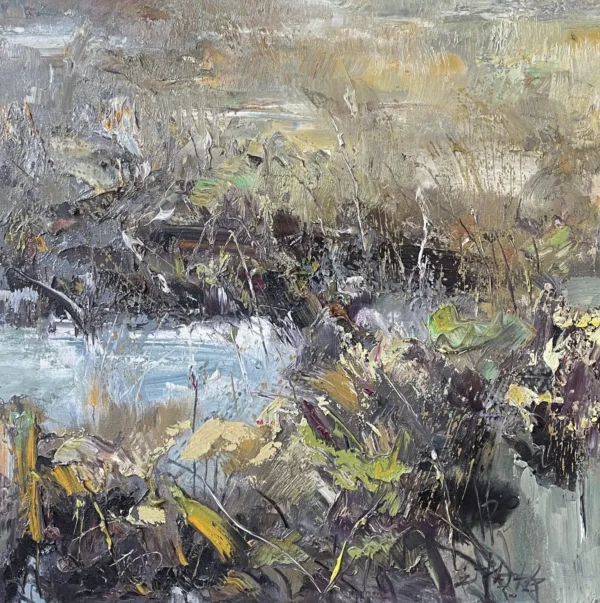
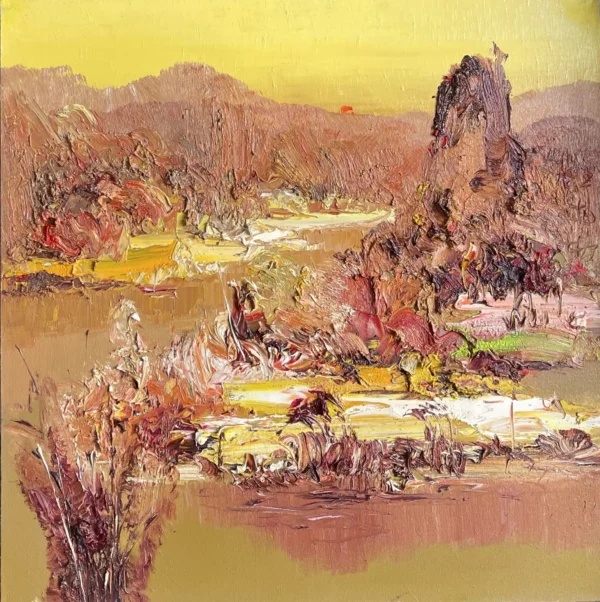
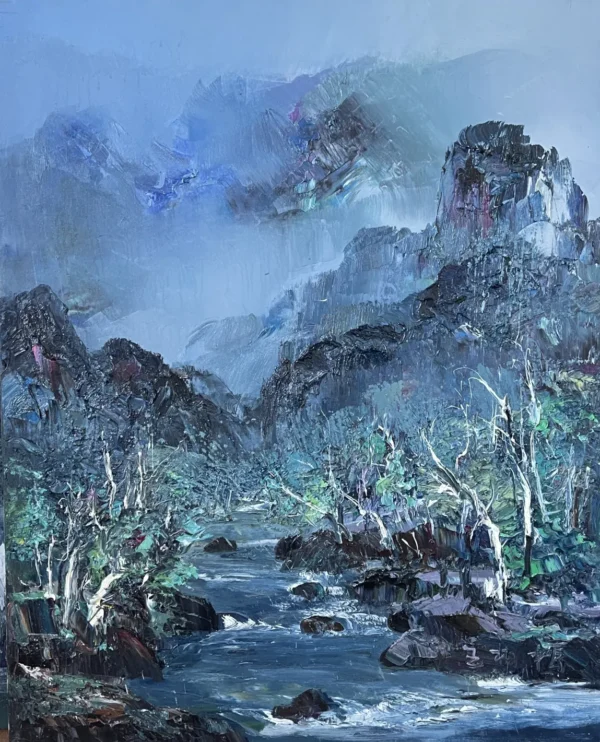
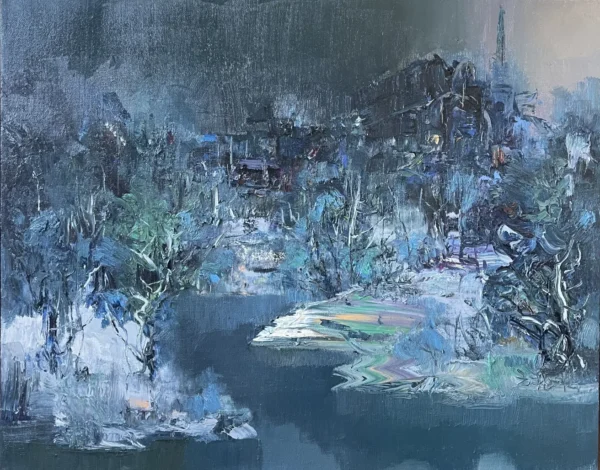
Wang Baisong parvient à capturer non seulement l’essence visuelle de l’automne, mais aussi ses résonances émotionnelles et spirituelles. La technique expressive de l’artiste, combinée à une palette chromatique intense, confère au tableau une dynamique particulière. Il s’agit moins d’une simple représentation d’un paysage que d’une méditation sur la nature, le temps et le cycle perpétuel de la vie. L’œuvre, à travers sa complexité technique et symbolique, invite à une réflexion sur le passage inévitable des saisons et des époques, mais aussi sur la beauté inhérente à cette impermanence. L’influence de la tradition chinoise est omniprésente dans la manière dont Wang aborde la nature, faisant de « Driving Autumn » une œuvre profondément imprégnée de la philosophie esthétique et spirituelle de la Chine ancienne, tout en y intégrant des éléments stylistiques modernes.
100 x 80 cm
Explorez la collection de peinture figurative de Baisong Wang (s’ouvre dans un nouvel onglet), un artiste contemporain chinois reconnu en Chine et à l’international.


Analyse de l’œuvre « Driving Autumn » de Baisong Wang (80 x 100 cm)
Analyse technique : « Driving Autumn » est une toile peinte à l’huile, une technique que Baisong Wang maîtrise avec une grande virtuosité. L’épaisseur de la matière, appliquée en larges coups de pinceau et de couteau, crée une texture dense et riche qui donne vie à un paysage automnal en fusion. Les empâtements présents, particulièrement sur les arbres et le sol, traduisent une volonté de rendre la matière organique tangible. Le choix de la peinture à l’huile permet ici de jouer avec des contrastes vibrants entre les couleurs chaudes de l’automne et les nuances froides du ruisseau. Le geste de l’artiste est libre, presque sauvage, ce qui confère à la toile une vitalité et une énergie indéniables.
Analyse stylistique : Le style de Wang dans « Driving Autumn » est clairement influencé par un mélange de réalisme et d’expressionnisme. Le réalisme se manifeste dans la représentation fidèle des éléments naturels, comme les arbres, le ruisseau et les rochers. Cependant, l’aspect expressif se révèle dans l’intensité des couleurs et la force du geste. L’utilisation de tons de rouge, d’orange, de jaune et de brun pour les feuillages crée une sensation de chaleur et de mouvement, renforçant l’idée d’une nature en pleine transformation. Les touches de blanc et de bleu sur l’eau et les rochers suggèrent l’arrivée du froid, une transition entre l’automne flamboyant et l’hiver imminent. Le traitement des formes est également très dynamique : les arbres sont indistincts à première vue, presque fondus dans l’atmosphère du tableau, renforçant une impression de flux et de transformation. Baisong Wang adopte ici une approche semi-abstraite, où les contours ne sont jamais rigides, mais au contraire soumis à une interprétation émotionnelle.
L’influence du style chinois traditionnel : Bien que la peinture à l’huile et l’expressionnisme soient des éléments centraux dans « Driving Autumn », Baisong Wang ne s’éloigne jamais de ses racines profondément ancrées dans la tradition chinoise. Son œuvre s’inscrit dans la continuité des grands maîtres paysagistes de la peinture à l’encre, où le paysage, loin d’être une simple imitation de la réalité, devient une méditation sur la nature et l’harmonie entre l’homme et son environnement. Dans « Driving Autumn », on retrouve cette influence à travers l’importance accordée à la relation entre le vide et le plein, l’intentionnalité du geste et la manière dont la nature semble vivre d’elle-même, respirant avec une énergie propre. Les arbres, légèrement esquissés avec des lignes souples et vibrantes, rappellent la calligraphie chinoise, où un seul trait peut capturer l’essence de la vie. Le jeu de la lumière et de l’ombre, bien que traité de manière plus texturée et colorée qu’en peinture à l’encre, reflète également la pensée traditionnelle chinoise selon laquelle l’univers est en perpétuelle transformation. Cette influence se manifeste également dans la manière dont Baisong Wang aborde le paysage. Ce n’est pas comme un simple spectacle visuel, mais comme une interaction entre la nature et l’âme humaine. Il invite le spectateur à contempler non seulement la beauté fugace de l’automne, mais aussi le passage du temps, une notion centrale dans la philosophie chinoise traditionnelle.
Analyse symbolique : « Driving Autumn » est une ode à la nature dans toute sa force et sa splendeur éphémère. L’automne, saison de transition, est souvent associée au déclin et à la beauté de l’impermanence. Dans cette œuvre, Wang magnifie cette symbolique en mettant l’accent sur le contraste entre la douceur des feuillages colorés et le mouvement tumultueux de l’eau. Le ruisseau, en perpétuel écoulement, représente la fuite du temps, la transformation inévitable des choses. Il est à la fois calme et mouvementé, reflétant l’ambiguïté de l’automne, à la fois paisible et annonciateur des rigueurs de l’hiver. Les couleurs dominantes – rouges et oranges – rappellent le feu, la passion et la vitalité, tandis que le blanc et le bleu du ruisseau évoquent la pureté et la fraîcheur, mais aussi le détachement émotionnel. Wang semble ici jouer avec l’idée d’une nature qui respire, où chaque élément, même s’il est en déclin, porte en lui une énergie créatrice. Les arbres se penchent vers l’eau, comme attirés par cette force de vie qui les dépasse.